
From Buenos Aires to Bucharest

A Romanian citizen suffered severe injuries after a road traffic incident in Argentina. Crystol Lasley explains how AP Companies came to the rescue
A Romanian national sustained severe polytrauma after being struck by a bus while crossing a road in Buenos Aires, Argentina. The patient was admitted to a network provider facility coordinated through AP Companies.
The accident resulted in multiple lifethreatening injuries including extensive rib fractures, sternal trauma and pelvic fractures, accompanied by significant blood loss with haemoglobin levels dropping to 6.9. Additional complications included subcutaneous emphysema of the left hemithorax requiring pleural drainage. Due to the severity of the trauma, three surgical procedures were required to stabilise the patient, followed by a prolonged stay in the intensive care unit (ICU).
Answering the call
AP Companies’ team was notified on 18 March shortly after the admission and immediately initiated coordination with the treating hospital. Over the following weeks, the team maintained daily communication with ICU physicians to monitor the patient’s condition, review treatment decisions and continuously assess the medical feasibility of eventual repatriation.
The case required ongoing clinical oversight alongside operational coordination. During the ICU stay the patient underwent extensive diagnostic testing including CT scans, MRI imaging, laboratory testing, ultrasounds and multiple radiological studies.
Given the anticipated cost of prolonged intensive care and surgical treatment, continuous cost monitoring was conducted throughout the hospitalisation.
AP Companies also engaged in discussions with the provider regarding billing and potential cost adjustments while ensuring that treatment decisions remained fully aligned with the patient’s medical needs.
Stabilisation and readying for transfer
After 21 days in intensive care the patient’s condition stabilised sufficiently to allow transfer to the general ward. At this stage the focus gradually shifted toward recovery planning and evaluating repatriation options.
Following a detailed medical assessment and consultation with the treating physicians, the patient was eventually declared fit to travel on commercial flights. Considering the complexity of the injuries and the long-haul distance involved, the repatriation required careful planning and coordination with multiple airline medical departments.
The travel itinerary included two flight connections and required continuous assistance throughout the journey. Wheelchair support and a travel companion were arranged, and ground ambulance transportation from the hospital to the airport in Buenos Aires was coordinated to ensure a safe transfer.
In parallel, AP Companies organised the continuation of medical care in Bucharest, Romania. Based on the recommendations of the treating physicians in Argentina, an orthopaedic consultation and admission to an inpatient rehabilitation facility in Bucharest were arranged in advance.
Flying to Bucharest
Ambulance transportation from the airport to the rehabilitation centre was prepared prior to arrival, ensuring the patient could be transferred directly to the facility under appropriate medical supervision.
Upon arrival in Bucharest, the local medical team received the patient together with full medical documentation and case briefing provided by AP Companies. The patient subsequently continued treatment under the supervision of orthopaedic specialists and a dedicated rehabilitation team.
The operation involved coordination across multiple healthcare systems and a long-haul repatriation journey of more than 11,000km between Argentina and Romania.
This case illustrates the complexity of modern international medical assistance, where clinical monitoring, logistical coordination and cost containment strategies must operate simultaneously to ensure both patient safety and continuity of care across borders.
Crystol Lasley serves as Director of Maritime Operations at AP Companies, overseeing maritime medical assistance, evacuations, and crew healthcare services worldwide. With a nursing career that began in 1989 in the US Navy and Air Force, and later with Carnival Cruise Lines and as a founding member of VIKAND, she has extensive experience in maritime healthcare.
April 2026
Issue
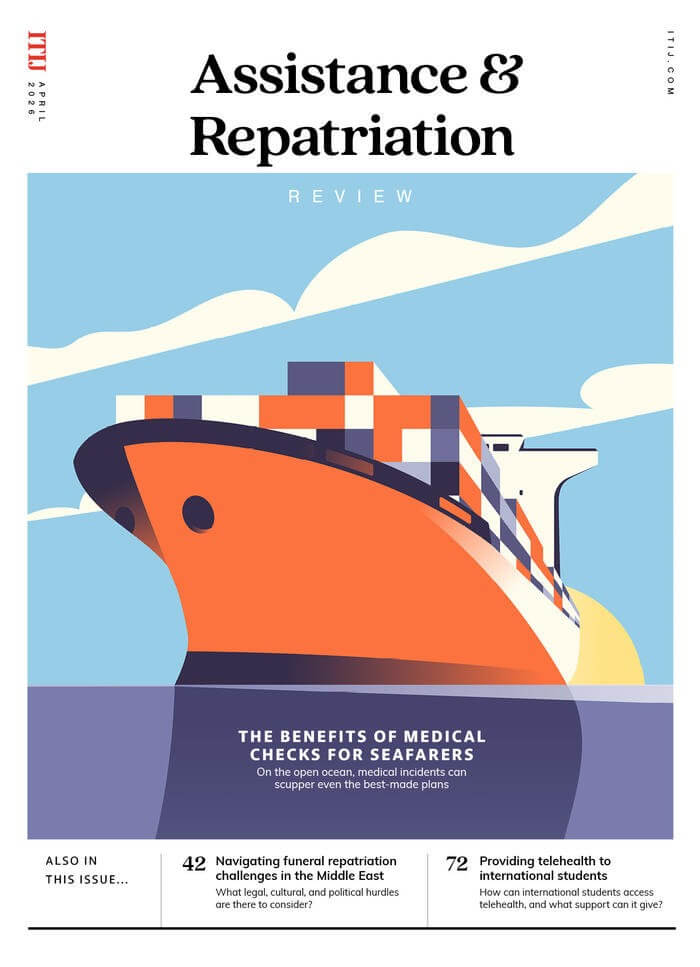
In the first Assistance & Repatriation Review of 2026, we explore the cultural, legal, and logistical intricacies of funeral repatriation in, around, and out of the Middle East. We also consider how pre-deployment medical assessments can save lives and sea voyages. The burgeoning demand for telehealth among students is covered in our third feature, plus we look at how companies are delivering services that meet that need.
Editorial Team
The Editorial Team updates the ITIJ website daily, and works on features for the print edition. With expert industry knowledge and years of experience in writing about complex travel insurance issues, the Editorial Team is ready to investigate and report on the topics that matter most to ITIJ's readers.