Bringing a loved one home

Fiona Greenwood from Rowland Brothers International talks about different countries’ approaches to embalming and preparation
When a bereavement occurs overseas, families face not only grief, but also distance, unfamiliar procedures, and uncertainty. At home, support networks and information are close at hand, and processes are generally understood. Abroad, documentation and local requirements can differ significantly, and further investigations may still be required after the deceased returns to the UK. Managing these practicalities – alongside the emotional and financial impact – can feel overwhelming.
We support families through this process by explaining what will happen next, answering questions, and coordinating the steps required to bring their loved one home. One of the most important and sensitive topics is whether viewing will be possible on arrival.
Preparation of the deceased is a key requirement for international transportation, but expectations and standards can vary. Airlines typically require the deceased to be in a sanitary condition and may ask to see an embalming or sanitisation certificate before agreeing to carry the deceased. For families, that certificate can provide reassurance and may shape expectations about viewing. However, HM Coroner may need to carry out further enquiries once the deceased is back in the UK, and embalming can sometimes limit the ability to investigate the cause of death.
One of the most important and sensitive topics is whether viewing will be possible on arrival
Embalming varies around the world
It is also important to understand that ‘embalming’ is not a single, consistent process worldwide. It may refer to anything from external washing and preparation to full arterial embalming. In some countries, arterial embalming is not routinely available.
Cultural and religious considerations can also be significant: some families expect embalming as standard, while others request that it is avoided in line with their faith. In countries where funerals take place quickly, embalming may not be offered at all or may be available only at additional cost. In certain circumstances, it may be possible to arrange for an embalmer to travel overseas (subject to local approval), but this can add time and expense.
In countries where funerals take place quickly, embalming may not be offered at all
Even where a certificate is provided, it cannot guarantee that the level of preparation will meet UK funeral directors’ or families’ expectations, as methods and terminology differ between countries.
In every case, we work to repatriate the deceased in the best possible condition and to set clear, compassionate expectations. Where viewing may not be advisable – particularly following a serious accident – we will discuss this carefully with the receiving funeral director, who can guide the family to make the right decision. Where appropriate, specialist reconstruction services may be available to support a dignified final farewell.
Fiona Greenwood is the Operations Director at Rowland Brothers International. A bilingual English/Spanish speaker, she has over 26 years’ operations management experience in the emergency assistance travel and claims industry handling leisure, corporate, and expatriate books of business in the UK and the US. Plus 15 years with Rowland Brothers International managing all operational aspects of domestic and global international funeral repatriations.
April 2026
Issue
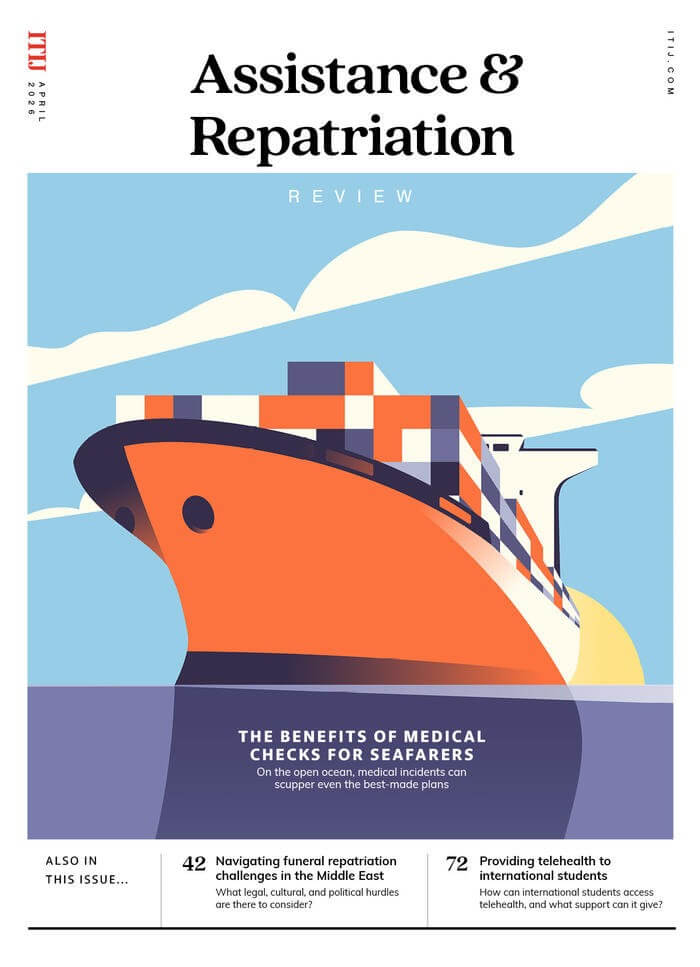
In the first Assistance & Repatriation Review of 2026, we explore the cultural, legal, and logistical intricacies of funeral repatriation in, around, and out of the Middle East. We also consider how pre-deployment medical assessments can save lives and sea voyages. The burgeoning demand for telehealth among students is covered in our third feature, plus we look at how companies are delivering services that meet that need.
Editorial Team
The Editorial Team updates the ITIJ website daily, and works on features for the print edition. With expert industry knowledge and years of experience in writing about complex travel insurance issues, the Editorial Team is ready to investigate and report on the topics that matter most to ITIJ's readers.