In the blink of an eye

Johannes Hoischen from Malteser AeroMedical tells us about a patient who needed an intensive care transfer to Germany from Egypt after a shocking accident
A 35-year-old woman from Germany was enjoying a diving holiday in Hurghada, Egypt, with a group of friends. After a long day on the water, they boarded the tour operator’s minibus for what should have been a routine journey back to their accommodation.
They never arrived.
During the transfer, the minibus was involved in a severe frontal collision with another bus. The patient had been sitting in the front passenger seat without a seat belt. The force of the impact threw her through the windscreen of the minibus and into the windscreen of the oncoming vehicle, where she became trapped.
The impact
When emergency responders reached the scene, they found her critically injured. She had sustained severe head and facial trauma, extensive injuries around the eyes, multiple rib fractures, plus fractures to both her upper and lower limbs. Immediate lifesaving treatment was required before she could be transported to a hospital in Hurghada.
There, she underwent several emergency surgical procedures. The extent of her craniofacial injuries, combined with the risk of further neurological complications, meant that she had to remain intubated and mechanically ventilated.
For the first few days, transport was not an option. The immediate priorities were to stabilise her neurological condition, control the bleeding, manage the fractures and reduce the risk of secondary complications. Only once these urgent issues were under control could the possibility of returning her to Germany be considered.
The planning
The patient’s family had been informed, and her insurer’s assistance service was involved. Given the complexity of the case and the need for an intensive care transfer, Malteser AeroMedical was commissioned to organise and carry out the repatriation.
Cases such as this also show why repatriation after major trauma cannot always take place immediately
From the moment the case was assigned, the Malteser AeroMedical team worked closely with the treating physicians in Egypt and its local partners. Her condition was reassessed repeatedly. Particular attention was paid to intracranial stability, airway security, ventilation requirements and haemodynamic control. In a case of this severity, determining the right moment to transport the patient was just as important as planning the flight itself.
A transfer on a scheduled commercial flight was ruled out. The patient required a dedicated air ambulance equipped for intensive care, with an experienced aeromedical team able to manage a ventilated patient throughout the journey.
Every part of the mission had to be carefully prepared. The flight plan needed to allow for uninterrupted ventilation, reliable sedation and pain management, continuous monitoring and safe positioning despite the patient’s multiple injuries. The team also had to consider the physiological effects of altitude and ensure that any changes in her condition could be managed immediately.
The repatriation
Once she was considered stable enough to fly under intensive care conditions, Malteser AeroMedical dispatched an air ambulance jet to Hurghada. Before departure, the medical crew carried out a final assessment at the hospital and coordinated the ground transfer to the airport. The handover was planned in detail to ensure that there was no interruption in treatment at any stage.
The patient remained intubated and ventilated for the entire flight. Her vital signs were continuously monitored, while the aeromedical team managed her ventilation, sedation, pain relief and overall clinical condition from takeoff through to arrival in Germany.
After landing, she was transferred directly to a specialist hospital, where further surgical treatment and rehabilitation could continue.
Cases such as this also show why repatriation after major trauma cannot always take place immediately. Being fit to fly does not mean that a patient has recovered; it means that their condition is stable enough for intensive care to continue in the aircraft environment. Even in a pressurised cabin, the pressure is lower than at sea level, which can affect oxygenation and must be considered carefully in patients with serious neurological and respiratory injuries.
Johannes Hoischen, based in Cologne, Germany, is currently the Head of Malteser AeroMedical as well as International Network at Malteser Assistance. With extensive experience in both assistance and medical transports, he is passionate about delivering the highest quality and service for Malteser’s members and clients all around the world.
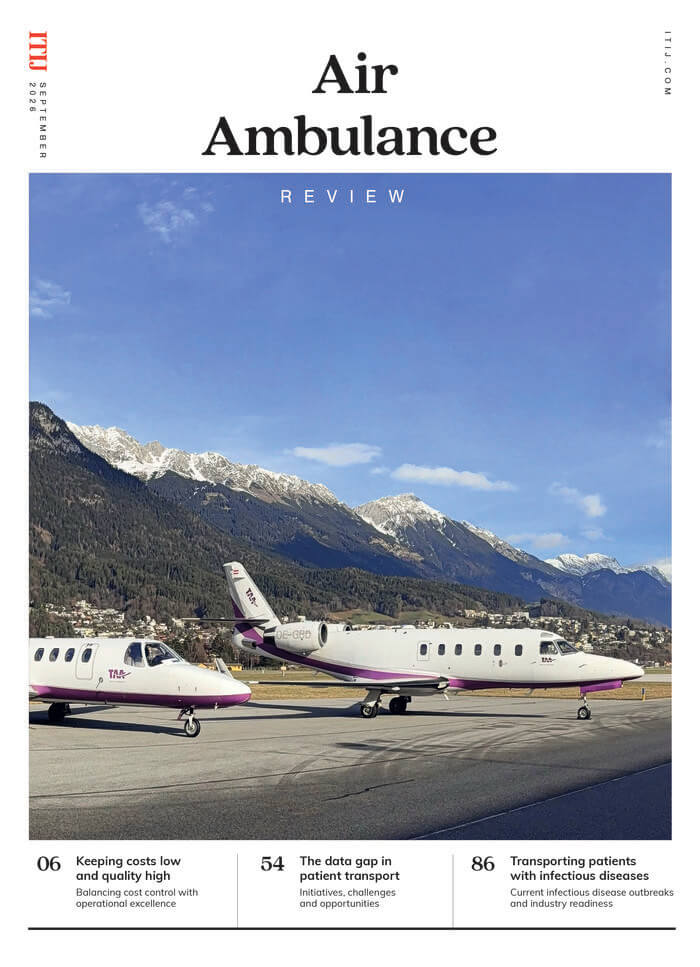
September 2026
Issue
This issue we focus on the problems that rising costs are having on the industry. Air ambulance providers are facing costs across fuel, aircraft maintenance, staffing, insurance, regulatory compliance, and specialist medical equipment. As if that wasn’t enough, delayed payments from insurers are adding further financial pressure. Despite these challenges, providers agree that patient safety and clinical quality must not be compromised.
Editorial Team
The Editorial Team updates the ITIJ website daily, and works on features for the print edition. With expert industry knowledge and years of experience in writing about complex travel insurance issues, the Editorial Team is ready to investigate and report on the topics that matter most to ITIJ's readers.