Beyond proximity: a time-critical medical evacuation in southern Mexico

Dr Andrea Rodríguez of Logimedex recalls the case of a traveller who needed specialised care that could not be found locally
A male international traveller presented to a secondarylevel private hospital in Puerto Escondido, Oaxaca, after experiencing a two-day history of sudden-onset left calf pain, accompanied by mild chest pain and progressive dyspnoea on exertion.
Physical examination revealed tenderness of the left calf without significant oedema. The initial clinical assessment raised concern for deep vein thrombosis of the left lower extremity and possible pulmonary embolism. The patient was admitted for observation while diagnostic studies and further medical evaluations were initiated.
The hospital promptly began the diagnostic work-up. However, despite providing appropriate emergency care, the institution operated as a secondarylevel hospital and lacked the specialists, advanced diagnostic resources and vascular care capabilities required by the patient.
Further evaluation confirmed bilateral pulmonary emboli and deep vein thrombosis of the left popliteal vein and superficial thrombosis.
Recognising the limits of local care
The treating physicians notified that the patient required specialised vascular assessment, additional diagnostic studies and close clinical monitoring that could not be provided locally. They therefore recommended transfer to a tertiary referral centre.
Our case management team promptly shared the clinical recommendation and an assessment of the healthcare resources available within the region with the insurer. Together, the teams proceeded with the arrangements required to transfer the patient to a higher-level medical facility.
Ground transportation was evaluated; however, travel time to Mexico City was estimated at approximately six to seven hours. Considering the confirmed thromboembolic condition, the risk of clinical deterioration during a prolonged journey and the importance of accessing specialised care, air medical evacuation was identified as the safest and most appropriate option.
Coordinating multiple solutions simultaneously
Multiple air ambulance providers were contacted simultaneously to assess aircraft and medical crew availability and identify the most appropriate transport solution. One provider confirmed that an aircraft and specialised medical crew were available that same afternoon, allowing the transfer to move forward promptly.
In parallel, a tertiary referral hospital in Mexico City was contacted to coordinate admission. The patient’s clinical information and medical reports were forwarded to the Head of the Emergency Department to facilitate pre-arrival planning and ensure that the appropriate specialists and resources would be available.
At approximately 4:30pm, the air ambulance medical crew arrived at the referring hospital, completed the preflight assessment and confirmed that the patient was stable for transport. The evacuation proceeded as scheduled, and the patient arrived safely in Mexico City at approximately 9pm.
Because the receiving hospital had been notified in advance, its emergency department and specialist teams were prepared to receive the patient immediately, allowing continuity of care without unnecessary delays.
Continuity of care and outcome
Following admission to the tertiary referral centre, the patient underwent specialised evaluation and the required diagnostic studies. He received anticoagulation for the bilateral pulmonary emboli and venous thromboses, remaining hospitalised under close medical supervision until his condition improved.
Once medically stable, he was discharged and subsequently repatriated to Italy through arrangements made in coordination with his insurer.
The value of anticipatory case management
This case highlights the importance of distinguishing between healthcare availability and healthcare capability. Although the patient initially presented to one of the few hospitals available in the region, the institution lacked the specialised resources required for comprehensive vascular assessment and management.
Rather than focusing solely on geographic proximity, the coordination process prioritised access to the appropriate level of care. Simultaneous communication among the treating physicians, international insurer, air ambulance provider, receiving hospital and medical assistance team helped maintain continuity throughout a potentially time-sensitive emergency.
International medical coordination extends well beyond transportation logistics. It is a structured process in which healthcare resource assessment, communication, operational planning and continuity of care directly influence a patient’s timely access to appropriate treatment.
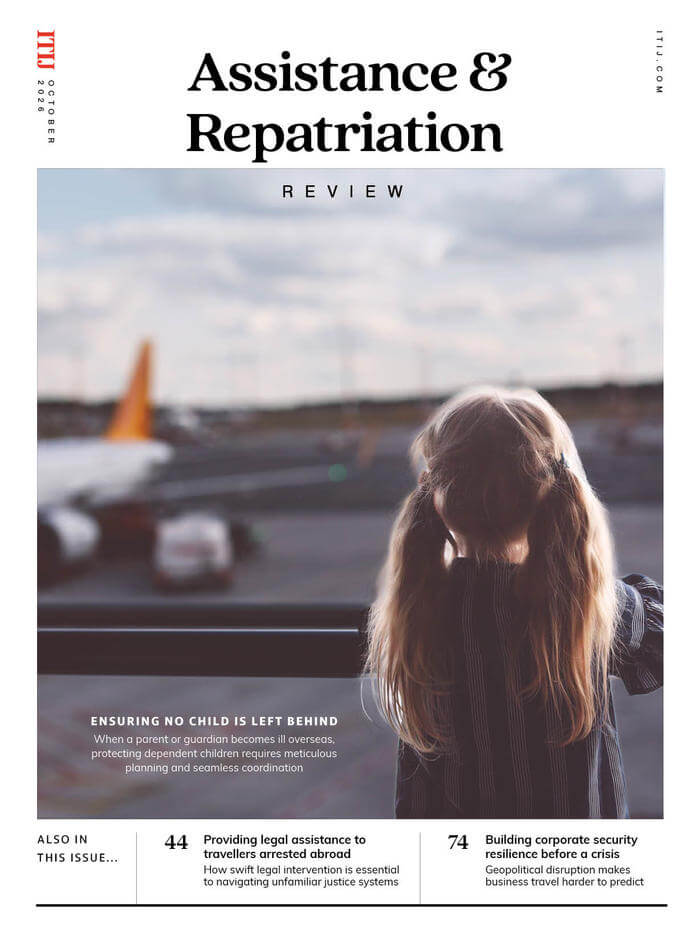
October 2026
Issue
When a parent or guardian becomes seriously ill overseas, assistance providers face a complex challenge that extends well beyond clinical care. Although these cases are relatively rare, in this issue we look at how safeguarding dependent children requires careful planning, legal awareness, and close international coordination.
Editorial Team
The Editorial Team updates the ITIJ website daily, and works on features for the print edition. With expert industry knowledge and years of experience in writing about complex travel insurance issues, the Editorial Team is ready to investigate and report on the topics that matter most to ITIJ's readers.