Bariatric patient repatriation

Malteser AeroMedical reports on a case involving the repatriation of a complex patient injured on board a cruise
Malteser’s Assistance Center was contacted by a highly distressed caller on a cruise off the coast of Norway. A German national in her late 50s was travelling alone and suffered from morbid obesity; her limited mobility required the use of a customised electric wheelchair.
Several days into her journey, the patient’s wheelchair became stuck in an automatic door, which caused a deep laceration to her lower leg. She was taken to the ship’s medical centre, where the wound was cleaned and dressed by the onboard physician.
Being alone and with limited mobility, she was unable to properly care for the wound. As a result, she developed a severe superinfection and began showing signs of a rapid decline, including fever, weakness, and early signs of sepsis.
As the patient’s condition worsened and her ability to move even with her wheelchair deteriorated, the crew attempted to evacuate her by helicopter.
Unfortunately, due to her weight and the dimensions of her body, the aircraft could not safely accommodate her and evacuation had to be aborted.
The ship diverted to the nearest port in Norway, where the patient was disembarked and transferred to a regional hospital. She was admitted to the intensive care unit (ICU) for stabilisation and treatment of her infected wound.
Repatriation process
Once stable and able to communicate, the patient contacted Malteser AeroMedical’s Assistance Centre in Germany. The coordination team initiated a full medical evaluation, liaising with the ICU team in Norway, reviewing medical documentation, and preparing for a potential medical repatriation. The primary objective was to ensure continuity of care and bring the patient safely back to Germany, where – although she had no immediate family support – she could rely on her home medical infrastructure.
Given the patient’s condition and size, a Learjet 45 was selected for the mission. The aircraft was equipped with advanced medical equipment compliant with the patient’s weight and measurements as well as staffed with an extended crew, including a senior flight physician, a critical care nurse, and additional medical staff to support safe loading and unloading. The complexity of her transport required not just medical supervision, but careful logistical coordination due to her limited mobility and specialised needs.
Upon arrival at the regional Norwegian airport, the medical crew received a final briefing at the local hospital and proceeded to the tarmac with the patient. However, to their surprise, they were greeted not only by the waiting Learjet 45, but also by her electric wheelchair, which was being transported separately via forklift.
The wheelchair’s size and weight exceeded the aircraft’s cargo limitations and would not fit through the entry door of the Learjet. The patient initially refused to leave without her electric mobile support, but ultimately agreed that the safest option was to ship the wheelchair separately to her residence in Germany.
Once on board, the patient was made comfortable and monitored throughout the flight. Her condition remained stable, and she was medically supervised the entire way back to Berlin.
Upon landing, she was transferred by ambulance to a local hospital for continued treatment and recovery. Given that she lived alone, arrangements were made to ensure she would receive adequate medical and social support in the immediate post-repatriation phase.
A seemingly straightforward diagnosis quickly turned into a complex mission due to the unique challenges involved in transporting obese patients. Fortunately, Malteser AeroMedical is well-prepared for such specialised cases, combining years of experience with the appropriate equipment to ensure safe and suitable repatriation for every patient.
Johannes Hoischen, based in Cologne, Germany, is Head of Malteser AeroMedical as well as International Network at Malteser Assistance. Johannes is passionate about delivering the highest quality and service for Malteser’s members and clients all around the world.
September 2025
Issue
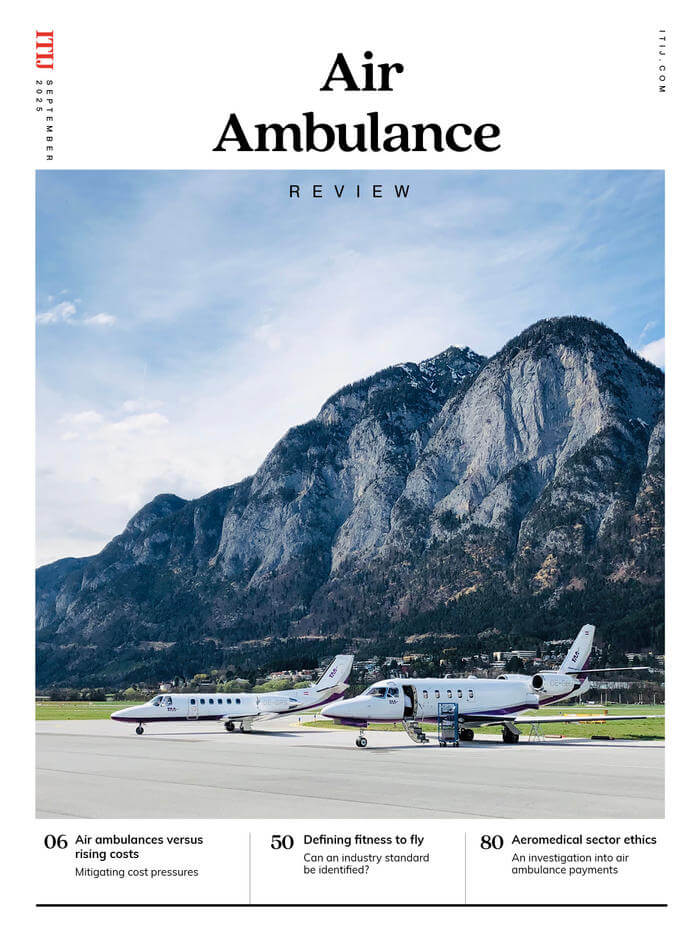
We include an examination on defining ‘fitness to fly’, and ask if an industry standard can be identified, and what that would involve. We also look at capacity in the aeromedical market and experts share their insights. Ethics and transparency in the aeromedical sector is a big issue, and we include an investigation into air ambulance payments.
Editorial Team
The Editorial Team updates the ITIJ website daily, and works on features for the print edition. With expert industry knowledge and years of experience in writing about complex travel insurance issues, the Editorial Team is ready to investigate and report on the topics that matter most to ITIJ's readers.