
Agility, empathy, and clarity

Oliver Cuenca speaks to Carl Guerard, Managing Director of CanAssistance, about the changing market for assistance
How has the assistance market changed in recent years?
The assistance job has really changed in the past 10 years, and even more so after the [Covid-19] pandemic. I would say the first element is customer expectations. People expect to have assistance right away. And customers don’t understand all the technical aspects, like that we need medical reports to be able to determine whether we can make a safe repatriation. They expect to be repatriated within the hour. So it’s about managing expectations.
There’s also the digital aspect of things – people expect to have more means to talk to us. So we have shifted our approach when it comes to making the proper decision at the proper time, and also ensuring we communicate with our customers in a proactive fashion, managing expectation. How does the customer want to be communicated with? Do they want to have phone calls every week, every day, every four hours?
AI is in the back office, while our staff is in the front end. We don’t want to lose that touch with the human aspect
Also, not every assistance case is the same. We don’t assist the same way in Florida, as an example, than in Africa or in Asia, so our staff have to be really agile in making the proper decisions and the proper support. And my role within the organisation is really to give [them] the tools, such as artificial intelligence (AI), to speed up locating the information, so they can provide a more human aspect.
We really put lots of emphasis on the human conversation, especially [with] someone that’s in a stressful situation when they need, like, urgent care. I want my staff to focus on the person, on the individual, and I want AI to work in the background, to give them, you know, the tools and the information in a timely fashion, in a consistent way.

Is AI a big focus for your company?
Yeah, in past couple of years we’ve really seen the opportunities of using AI. Like, for instance, when adjudicating claims. It used to typically take half an hour to look at all sorts of documentation manually. Now, we use AI. We built a tool which is called Real-Time Adjudication Assistant, and the AI does all the hard work. It’s all about document translation, document identification.
Another aspect is assistance. There are so many different contracts. Typically we hire someone that works in our assistance desk that used to work at a different call centre. And we expect them, in three months, to know all about the contracts, to know all about the hospitals, to know all about the different locations, to know all about the assistance companies. And we expect them to know about medical conditions, right?
So we use AI to understand the situation and to also locate the contract information for them, to locate what is the proper network in that country, to give them advice in terms of what is the proper course of action … so that our staff can expedite assistance. We saw a shift in the average handling time from a much longer duration down to a shorter duration, but also improvement in providing consistent information to our customers. Again, AI is in the back office, while our staff is really in the front end. We really don’t want to lose that touch with the human aspect.
Have current issues surrounding US-Canadian relationships affected your business in any way?
Yeah, Canadian travel to the US has declined, I would say by more than 20% in comparison to 2024. And I don’t want to point out that this is the Trump effect, but you know – you’re a Canadian, you’re 65 years old, and when you see all this on TV, you might want to try different destinations.
And we saw the shift – more [people] are going to Europe, going to Asia, even travelling domestically [around] Canada in the summertime. There are some really nice places in Canada that people like to travel to in the winter. And obviously our snowbirds want to avoid the winter, so they go south – but more now go to Mexico, the Caribbean, Cuba.
When it comes to the healthcare system and transparency, comparison and our service culture, our operations are built around empathy and clarity
So we have had to adjust. We added some support all over the world – we already work with 27 assistance companies, but we need to get more precise in terms of some different locations. Like when people climb Everest – we see more trips like that now, “vacations of a lifetime”, where they get injured or they get sick. We have to have more tools in our toolbox to be able to be precise in the way we do assistance, offer proper health support, and provide customer experience and all of that, taking into consideration the economics.

Are there any advantages or disadvantages to being an assistance company based in Canada?
When it comes to the healthcare system and transparency, comparison, and our service culture, our operations are built around empathy and clarity. We also understand the landscape of North America, and we’re fully bilingual. Obviously, people that travel from Quebec are mainly French-speaking individuals, so we’re able also to communicate with them in French.
I would say that understanding the network, the landscape, the language, the culture, really gives us an advantage. I’m not saying that European companies are not in a good position to provide assistance for Canadian travellers, but there’s something special about us Canadians. We’re very close to our own, you know, Canadian folks. And support makes a difference – especially for travellers who are far away, in Asia or in Australia. Having a familiar voice that understands you makes a big difference.


How is CanAssistance looking to evolve their business into the future, say, five years from now?
Our partners make a huge difference. Back three years ago, we used to handle repatriation in-house. And at some point I said, what’s our strength? What do we do best? We provide assistance and we provide medical care guidance. That is what we do best. So let’s find a partner that is good at taking care of logistics, someone that works in the aviation industry, that understands how travel agencies work, that understands how air ambulance works. And we did, and I’d like to name them, because I think they do a fantastic job. They’re called JB Aviation Services.
So really I would say that part of our future is to align with the best partners out there, really focus on the customer experience and economics, and improve the digital and clinical innovation.
Our philosophy moving forward is really to be listening to our customers. I think they’re so important, because if we can hear what our customers are saying about us, and understand also the landscape, the market, we can adapt quickly and be very agile in the way we do assistance.
April 2026
Issue
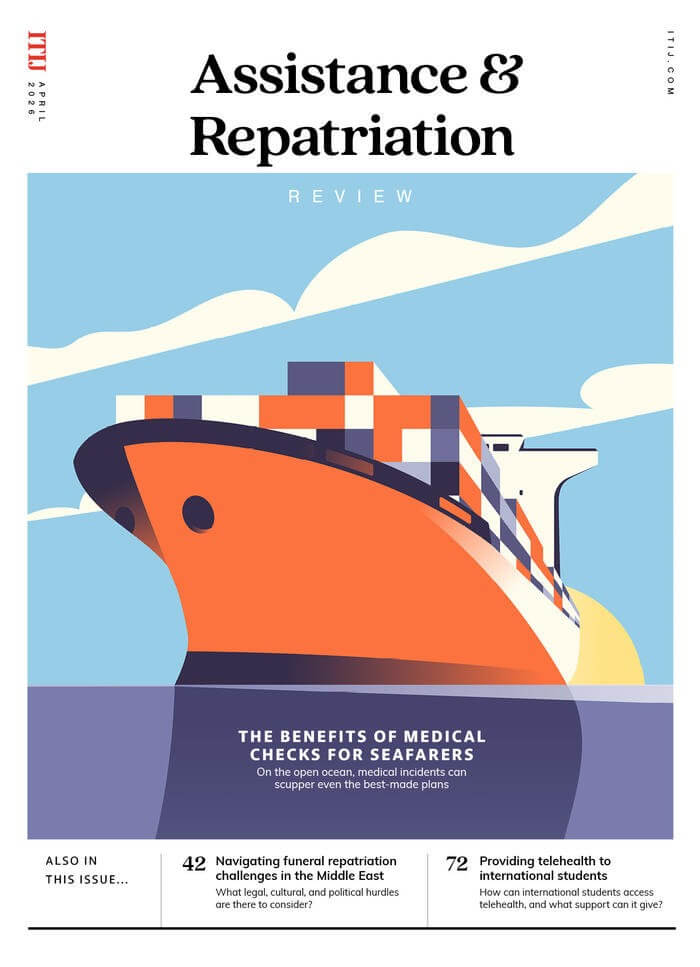
In the first Assistance & Repatriation Review of 2026, we explore the cultural, legal, and logistical intricacies of funeral repatriation in, around, and out of the Middle East. We also consider how pre-deployment medical assessments can save lives and sea voyages. The burgeoning demand for telehealth among students is covered in our third feature, plus we look at how companies are delivering services that meet that need.