
Aerospace and the future of space flight

Dr Jon Sen, Chief Medical Officer at Mayday Group, on rocket science meeting brain surgery
Progress in aviation and aerospace has been remarkable since the 1960s, when Vostok, Soyuz, Gemini, Apollo and other endeavours captured our imaginations for the possibilities of a human presence in space. More recently, SpaceX has transformed the landscape of the aerospace sector. Following a long hiatus after the end of the space shuttle era, space is revitalised once more, a new era of regular private
commercial space flight is becoming a reality, and the Artemis programme aims to take us back to the Moon, with onward crewed missions to Mars.
Brain dynamics
Whilst much of the focus has been on developing rocket science for solar system exploration, we now play catch-up trying to improve our understanding of the effects of the space environment on human physiology. This opportunity now presents itself again, with the recent increase in industry activity.
Some of the general effects of microgravity and solar and cosmic radiation on the human body are becoming elucidated, but the effects of these hostile conditions on the brain may
prove to be the key limiting factors for longer duration space travel. The brain has evolved in almost numberless forms over the aeons, the Homo sapiens’ brain becoming the crown
jewel of all biology.
The brain has evolved in
almost numberless forms over
the aeons, the Homo sapiens’
brain becoming the crown jewel
of all biology
The most complex structure in the known universe, it is bricked away in a secure vault like no other organ, and develops in life
in an extremely interdependent manner with its surroundings.
This degree of sophistication has, however, manifested just once in the universe as far as we are aware, and has emerged in highly specific conditions within Earth’s gravitational field (1G) and beneath the Earth’s protective magnetosphere. With extreme sophistication comes vulnerability, and we now know from pre and post-flight MRI scans that once in the space environment the brain swells due to altered fluid dynamics, leading to a constellation of neurological and ocular problems, known as Spaceflight Associated Neuro-Ocular Syndrome (SANS). The brain swelling and raised intracranial pressure is
transmitted via the optic nerves to the eyes, causing visual deficits that remain persistent after return to Earth.
New research
Following our previous research on the Axiom-2 mission to the ISS last year, looking at multiple aspects of brain function, including preliminary work on SANS, we carried out further SANS experiments on astronauts aboard the recent SpaceX Polaris Dawn mission (the first of three missions for the
Polaris SpaceX programme) which launched into high orbit on 10 September 2024. This investigation utilised a novel and portable method of monitoring brain pressures via pupillary responses to infra-red light (pupillometry) and which will be crosscorrelated with additional pre and post-flight brain MRI scans.
The pupillometry device was originally developed for monitoring the brains of critically ill neurosurgical patients in intensive
care environments but has now been sent into space to be assessed as a potential neuromonitoring tool for future spaceflight. It is a critical conjunction of rocket science
and brain surgery with potential to become a lynchpin of future risk management and clinical protocols, which will become ever
more important as the era of commercial space flight continues to grow. The data from Polaris Dawn will be published in due course.
See also:
• Neuroscience Research in Short-Duration Human Spaceflight (Shirah Ed.), September 25, 2024; Imprint: Academic Press, Elsevier, Paperback ISBN: 9780443339189.
• Shirah B, Sen J, Naaman N, Pandya S. Automated Pupillometry in Space Neuroscience. Life Sci Space
Res (Amst). 2023 May:37:1-2.
• Documentary: Axiom-2: A Step Beyond
Dr Jon Sen Chief Medical Officer, Mayday Group
Dr Sen is a Medical Director at the Mayday Group, has a research programme at Keele University (Senior Clinical Lecturer with Neural Tissue Engineering Keele and Biomaterials), and teaches neurosurgery and neuroscience to medical students at the University of Nottingham Medical School. Alongside extensive experience in neurosurgery, he has carried out over 400 medical retrievals and transfers worldwide. He also has a research programme in Aerospace and Space Neuroscience.
November 2024
Issue
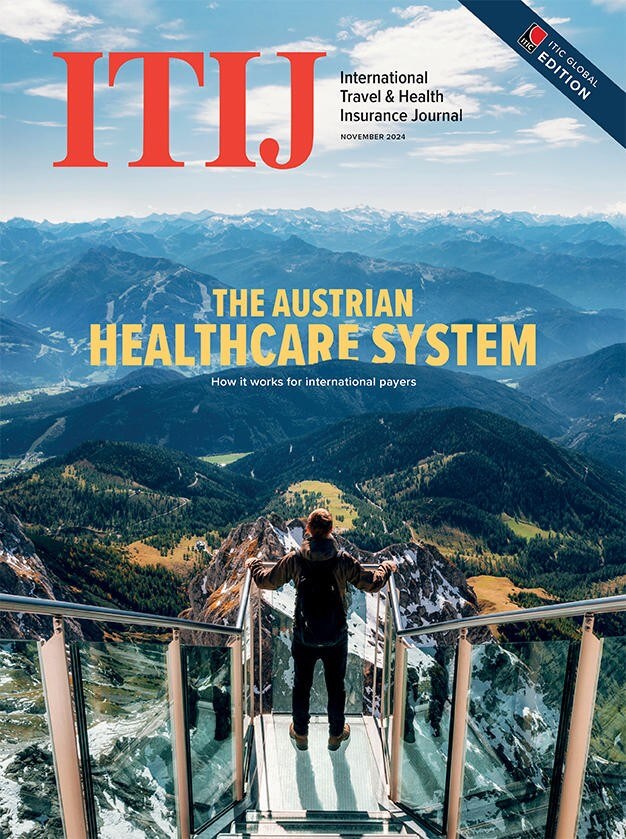
This month we look at affinity partnerships and ask if online travel agencies are the perfect partners for insurers; we cover the trends around cruising in the Mediterranean; we delve into the specifics of the Austrian healthcare system; plus we examine international healthcare and technology, asking how far can technology go.
Editorial Team
The Editorial Team updates the ITIJ website daily, and works on features for the print edition. With expert industry knowledge and years of experience in writing about complex travel insurance issues, the Editorial Team is ready to investigate and report on the topics that matter most to ITIJ's readers.