
Adam Hickman interview: From startup to specialist – growing a global medical assistance company

As medical assistance providers face increased operational, geopolitical, and technological challenges, Medresq’s CEO and Co-Founder, Adam Hickman, explains how agility, expertise, and culture are helping the business stand out
Q. Tell us a little about your role at Medresq – what does a normal day look like for you?
My role has evolved significantly since Medresq’s humble beginnings back in 2018. In the early days as a startup, I was deeply involved in day-to-day operations – directly supporting customers and patients overseas, drawing on my own experiences in the field. That hands-on problem-solving, supporting people in difficult situations, was what I loved most about assistance work.
As the company has grown, I’ve naturally stepped back from operations and brought in people who are frankly more capable and better qualified to deliver that support than I was. My role is now mostly strategic – looking at company structure, identifying where we’re going next, and continually looking for ways to improve and develop our business.
A ‘normal day’ really depends on whether I am working from our head office, working from my home office, travelling to meet clients, partners or attending conferences and events. I have three daughters under 10, so mornings in our house can be quite hectic. I often joke that I go to work for a rest; however, the reality is it is just a very different set of challenges!
The whole travel industry has faced unprecedented challenges over the past six years – from a global pandemic to geopolitical instability and rapidly evolving cyber threats
My day is normally a mix of meetings with different members of our management team and spinning a number of my own personal tasks and projects. There is always a call or two with our COO, Stuart, to discuss any operational challenges or help find solutions to complex cases. I secretly enjoy these… anything to distract me from contracts and spreadsheets!
Q. How is Medresq working to grow its operations? Are there any markets, service types or demographics that you’re looking to expand into?
At Medresq, we’ve always been focused on being the best medical assistance provider we can be. Assistance as a sector covers a broad range of services besides medical – security, travel risk management, and much more besides – but our team is dedicated purely to medical assistance services. That’s reflected in our operations team, where 80% are qualified medical professionals.
That specialism is actually a significant growth driver for us. It creates strong opportunities for strategic partnerships with organisations offering complementary services that are looking for genuine medical expertise to sit alongside what they do. We’re also increasingly working with larger businesses and organisations that want a dedicated, expert medical team which can integrate with their existing operations and travel risk infrastructure.


Q. What are the biggest challenges you would say are currently affecting the medical assistance and cost containment sectors? How is Medresq overcoming them?
The whole travel industry has faced unprecedented challenges over the past six years, from a global pandemic to geopolitical instability and rapidly evolving cyber threats. That turbulence has had a direct knock-on effect on medical assistance providers supporting both leisure and business travellers worldwide. The reality is that these disruptions aren’t going away, and the ability to react quickly and decisively is now a baseline requirement for any assistance company.
Covid-19 exposed many businesses that had become rigid in their operating models and struggled to adapt to a rapidly evolving crisis. In its wake, the industry has become more flexible – but this is where smaller, independent providers like Medresq can really shine. We have the ability to make significant, high-level changes to our services, infrastructure, and staffing at speed, in ways that larger, more bureaucratic organisations simply can’t. It’s an agility we’ve demonstrated time and again.
The security threat from the Middle East conflict has had a much greater operational impact, disrupting logistics and available routings
On the cost containment side, artificial intelligence (AI) and technology represent both a huge opportunity and a significant threat if not managed responsibly. We’re already seeing rising levels of sophisticated, AI-generated fraud – highly convincing fraudulent documents and medical bills that are presenting real challenges to the insurance industry.
The flip side of AI-driven fraud is the enormous opportunity technology presents – rapid access to information, smarter data processing, faster decision-making. But as an industry, we need to carefully balance how we harness these tools, ensuring technology enhances the quality of service rather than simply automating it in pursuit of cost savings.
At Medresq, we believe the focus on having the right people is more important than ever – and that technology should be used to empower those people to do what they do best.
Q. With the recent global disruption to jet fuel supplies, how has that particular crisis affected your operations?
In all honesty, the jet fuel crisis has not significantly impacted our ability to support our customers so far. Flight costs have certainly increased, and that will be felt by clients and underwriters who ultimately foot the bill for these services – but we haven’t seen a dramatic reduction in flight availability.

In reality, the security threat from the Middle East conflict has had a much greater operational impact, disrupting logistics and available routings through key hubs like the UAE, which has historically been one of the busiest centres for repatriation flights.
Where we have seen some disruption from fuel shortages is on longer-range air ambulance missions, where securing access to fuel in more small, remote locations – often critical stopover points for complex repatriations – has caused delays in planning. However, working closely with our air ambulance partners, we’ve managed to navigate these challenges without significant disruption to our clients.
Q. Medresq recently underwent a rebrand, including a new logo – tell us a little about the reasoning behind the company’s new brand direction.
The idea for a rebrand was first floated in the second half of 2024, with the project undertaken throughout early 2025 and launched that autumn. Five years feels like a significant milestone in any company’s journey – you’re emerging from those startup years having learned a great deal about your own identity, what the business truly means, and what your core values really are.
The driving motivation was to better represent who we are and what we do. A new logo is one thing, but the whole process was actually a highly reflective and defining one – a genuine opportunity to consider what we thought the business was going to be when we started, and how far it had come. What struck us was that the core mission hasn’t changed that much – it’s really the breadth and depth of our services that have evolved. With significantly more resources available to us, it was also a chance to sharpen everything up: the brand, the website, and our wider marketing materials.
Providing a 24/7, 365-days-a-year service means there is no downtime for the business – we are always on
The response has been really positive, and I think it gives us a strong foundation for the next five to 10 years. More than just a visual refresh, it truly represents where we’re heading and the industries we’re looking to support.
Q. Medical assistance can be quite a high-intensity business to be in – how do you work to ensure the wellbeing of your staff, while also maintaining a high standard of care for clients?
It’s an important question, and one we take seriously. Providing a 24/7, 365-days-a-year service means there is no downtime for the business – we are always on. As a growing company, that presents a real challenge, and the mental load that comes with processing complex, high-stakes information day in, day out can take its toll.
We actively encourage our team to open up and talk to each other about the pressures they face – in our experience, some of the best support comes simply from colleagues sharing with one another. While remote working has its place, we firmly believe in the importance of human contact, and we hold regular team contact weeks where everyone comes together for training and development, but just as importantly, to be around each other and share the load.
We also make sure that with the serious workload comes genuine fun – and we don’t do things by halves. From walks in the Peak District to climbing snowy peaks in Poland, from canal boats to cruise ships, we try to keep things varied and make sure there’s always something for the team to look forward to. Our work can be heavy and intense at times, and having fun is a great remedy to that – it’s one of the best tools we have for protecting mental health and bringing the team closer together.
That sense of team is one of our core strengths, and I believe it shines through in the service we deliver. As we grow, maintaining that close-knit culture is something I’m personally very committed to – it’s what makes Medresq what it is.
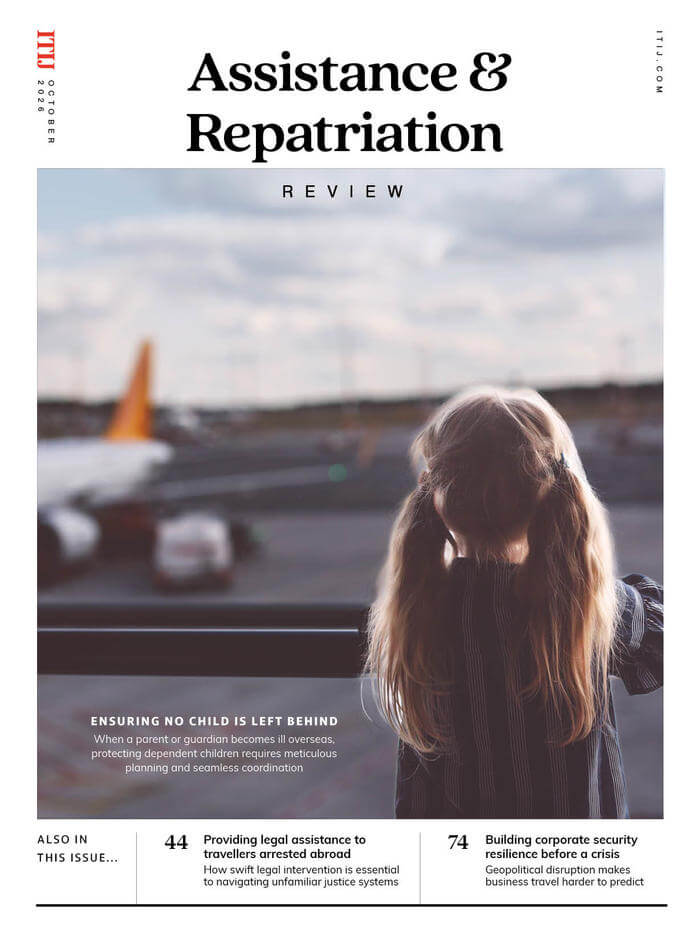
October 2026
Issue
When a parent or guardian becomes seriously ill overseas, assistance providers face a complex challenge that extends well beyond clinical care. Although these cases are relatively rare, in this issue we look at how safeguarding dependent children requires careful planning, legal awareness, and close international coordination.
Editorial Team
The Editorial Team updates the ITIJ website daily, and works on features for the print edition. With expert industry knowledge and years of experience in writing about complex travel insurance issues, the Editorial Team is ready to investigate and report on the topics that matter most to ITIJ's readers.