
Across the Pacific: navigating multiple jurisdictions to deliver global transfers

A LifeFlight air ambulance jet has carried out back-to-back missions, crossing the Pacific twice in one week to deliver high-needs patients to hospitals in the US and the Philippines
The missions involved coordinating with multiple authorities and agencies across jurisdictions to ensure a smooth journey and handover from the hospital teams and a safe arrival at the destination.
Missions
In the first mission on 7 July, an adult male recovering from a spinal cord injury and cervical vertebra fracture required a transfer from Tokyo to Atlanta to receive specialist neuro-rehabilitation care.
Just hours later, LifeFlight was preparing to launch the next mission from Miami in the US to Manila in the Philippines. This mission was carried out between 9 and 12 July and involved airlifting an adult male requiring ventilator support and ongoing respiratory management.
Challenges
Any missions involving multiple countries are bound to be complex, and the Tokyo– Atlanta flight was no exception. LifeFlight navigated Japan’s highly structured hospital discharge process and to-theminute airport slot times, requiring precise paperwork and timing to ensure the transfer connected with the patient’s scheduled US arrival.
Regulatory aviation practices provided another challenge. Across both missions, it was necessary to obtain numerous overflight and landing permits for multiple countries and territories across Asia and the Pacific.
In the case of the Philippines, LifeFlight needed to liaise closely with authorities for after-hours immigration and airside ambulance access at the airport.
Operations
Before each mission, LifeFlight ensured additional aeromedical crews were in place by organising commercial flights to the cities where crew handovers would occur. This meant any delays waiting for the handover crew were avoided so there could be a seamless transition.
Our skilled doctor and nurse teams were onboard for both journeys and flight crew were rotated to ensure they had the requisite rest and duty periods.
While the Atlanta mission was well underway, planning was in full swing for the Manila mission with applications made for the necessary permits and pre-departure clinical conferences held to ensure a successful flight and handover.
Medical support
LifeFlight’s medical crews worked meticulously over the course of the week to provide care to both patients over the two transfers. In the first mission, the crew took significant precautions to ensure the patient was handled carefully given the sensitive spinal cord injury.
In the second case, a broad range of measures were put in place to support the transfer, including full ventilator support, closed circuit infection control, and adjustments to the inflight feeding plan for the 18-plus hour transfer.
Final thoughts
“From our beginnings in Queensland to now consistently moving patients across the globe is the result of years of hard work and dedication. Every step along the way has been driven by a commitment to deliver the best possible service, and it’s that foundation that enables us to operate at this scale today,” says Tyson Smith, General Manager of Air Ambulance at LifeFlight.
The measures implemented led to both patients being handed over to specialist care in a stable condition and reunited with loved ones. LifeFlight has spent decades developing the people, processes, and equipment needed to successfully complete long-range complex aeromedical transfers, and the Atlanta and Manila missions are further evidence of this capability.
Tyson Smith is the General Manager – Air Ambulance at LifeFlight, overseeing more than 500 international and domestic jet retrievals each year. Tyson, with more than 12 years’ experience in the aeromedical operations sector, plays a key role in expanding LifeFlight’s global capability and continuously evolving clinical, operational, and commercial performance.
September 2025
Issue
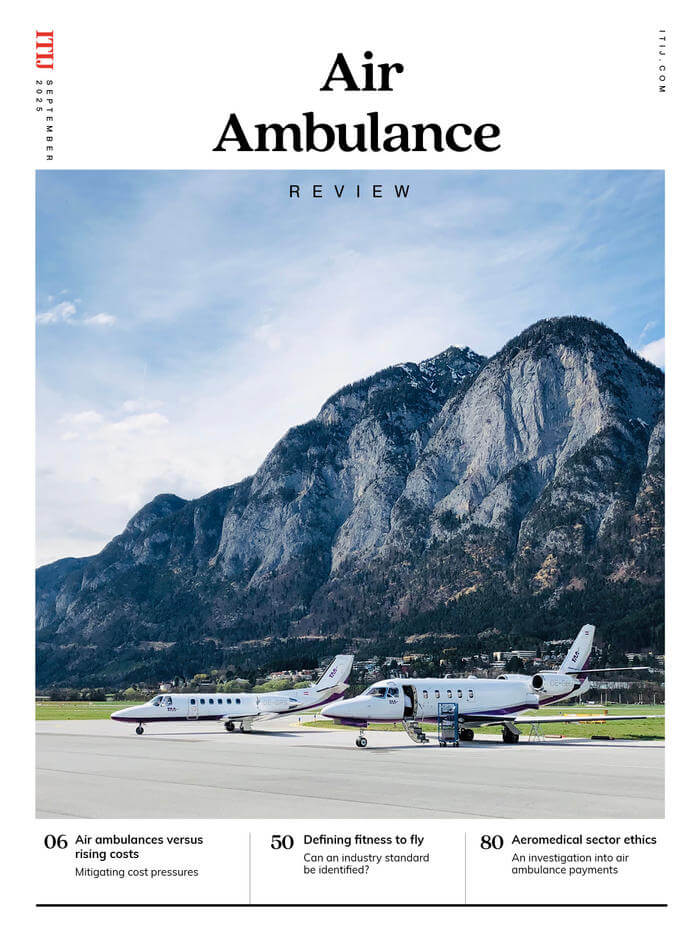
We include an examination on defining ‘fitness to fly’, and ask if an industry standard can be identified, and what that would involve. We also look at capacity in the aeromedical market and experts share their insights. Ethics and transparency in the aeromedical sector is a big issue, and we include an investigation into air ambulance payments.
Editorial Team
The Editorial Team updates the ITIJ website daily, and works on features for the print edition. With expert industry knowledge and years of experience in writing about complex travel insurance issues, the Editorial Team is ready to investigate and report on the topics that matter most to ITIJ's readers.