Managing cost containment through fraud detection

Robyn Bainbridge investigates how the travel insurance industry is adapting its approach to effectively manage cost containment through fraud detection.
Travel insurance is eternally adapting to meet the growing needs of a mobile, demanding population. But with increased market potential, there inevitably comes a heightened opportunity for fraud and double-dealing, and this can lead to inflated costs for insurers and hiked-up premiums for customers, amongst myriad other problems. For those that have already forked out for an expensive getaway, the benefits of coverage are often overlooked, and it’s clear that many feel a general level of demur towards buying travel insurance in the first place – hardly a helpful factor in the industry’s fight against fraud.
As if anyone needed convincing, let’s take a look at some unsettling figures: in 2017, members of the Association of British Insurers (ABI) detected £1.3 billion of general insurance fraud, and although, as Manager of Fraud & Financial Crime at the ABI Mark Allen highlighted, travel insurance is one of the smaller lines within general insurance, in 2017, the value of detected travel fraud was just under £3.5 million.
Sharing the cost of fraud detection may well be the industry’s most effective option
In addition, Louis Brun, Marketing Manager at Global Excel in Canada, noted that, according to the National Insurance and Bonding Commission (Comisión Nacional de Seguros y Fianzas) in Mexico, based on figures reported by local insurance and assistance companies, Mexican insurers paid out more than US$2.5 billion in accident and health claims in 2016. And in Central America, the Caribbean and South America, Brun added, reports on average state that 10 per cent of total claims can be considered as fraudulent – representing approximately $260 million in fraud claims annually. Very disconcerting indeed – and these figures only begin to scratch the surface of the global cost of fraud.

The many faces of fraud
From pre-inception loss to fraudulent medical claims, Global Fraud Manager at AXA in the UK, George Paxton, remarked that ‘the types of fraud vary depending on the types of insurance’. He said that more ‘regular’ types of fraud saw people ‘using insurance for something they know is going to happen, rather than that they hope doesn’t happen’.
Indeed, Julie Remmington, Director of J.A.R Consultancy in the UK, detailed that the most common travel insurance fraud committed by an insured is related to the baggage section of the policy, with exaggerated claims at one end of the scale and using fabricated documents for claims at the other. In terms of fraud within the medical system, she explained: “These are committed by both insureds and medical facilities and are usually of much higher value due to the nature of the policy coverage.”
Claire Byrne, Manager of Operations, Risk and Fraud Unit at Allianz Care in Ireland, told ITIJ that, with regards to medical insurance, fraud can be classified into one of two main categories: ‘soft or opportunistic fraud and organised or systematic fraud’. She noted that common examples of the former included exaggerated invoices, application fraud and replication of genuine invoices to reflect services that never took place, and even sometimes include membership card sharing to obtain treatment for non-insured persons. Meanwhile, examples of systematic fraud include the creation of false policies and/or providers, medical providers overusing benefits, billing for medical services not performed and co-ordinated medical referrals, as well as invoice re-direct fraud.
An example of systematic fraud pointed out by Remmington is an insured trying to obtain treatment that is not of an emergency nature (for example, cosmetic). She continued: “In cahoots with the medical facility, [they] will submit an invoice for the cost of treatment, but try and claim that it was for an accident/injury.”
identifying types of fraud that present the biggest cost burden to insurers is integral to developing prevention and detection technologies
Without a doubt, identifying types of fraud that present the biggest cost burden to insurers is integral to developing prevention and detection technologies and techniques that can help in curtailing these costs. Take, for example, a recent trend that Allen highlighted, involving travel sickness claims in the UK: 35,000 claims were made via hotel or travel firms’ business insurance rather than travel insurance in 2016 (an increase of 500 per cent on 2013), and these were often fuelled by claimant lawyers and claims management companies. Thanks to detection strategies already in place, the ABI is able to identify and flag potential fraudulent claims such as these.
Lastly, let’s not forget that, on occasion, fraud can occur unintentionally – sometimes an oversight, such as forgetting to update a policy, can lead people to unwittingly commit fraud, and in such instances the onus may well be on the insurer to more clearly define the terms of the coverage.
Nonetheless, there’s nothing worse than dishing out thousands of [insert currency here], in addition to the plummeting reputation amongst customers that rising premiums inevitably lead to.
So, what’s the answer?

Keeping costs low
You probably won’t be surprised to discover that the insurance industry has implemented a number of different methods of detecting and preventing fraud over the years. Cost containment is a key consideration within this process and, as it stands, different techniques prompt different results.
Paxton argues that the amount saved – which is often in the millions – all depends upon three key factors: firstly, how quickly the fraud is detected; secondly, the type of fraud being committed; and thirdly, the area of the world where the treatment is happening (if the claim is medical).
Indeed, time is of the essence when money is at stake. Going back to Paxton’s first factor, there are several techniques that insurers can employ to speed up the detection of fraud.
Firstly, both Allen and Remmington emphasise the importance of sufficiently training the claims department staff so that they can, as Remmington highlighted, ‘identify suspicious claims and launch an enquiry into it without prejudicing the insurers position’. A level head is integral to the fraud detection process, as unnecessary mistakes can cost the insurer – sufficient training in identifying trends and red-flagging fraud indicators is a long-term investment for insurers and will make fraud detection increasingly effortless (and cost-effective) as time goes on.
A combination of preventative and detective controls must be implemented to ensure the right balance between customer experience and cost containment
Paxton further emphasised this point. He noted that AXA works hard to ensure an anti-fraud culture within the business; putting emphasis on the role each employee plays in stopping fraud ensures that fraud detection is always a priority. “From training and specific referral triggers (into a team of specially-trained investigators) to using auditing and proactive claims reviews (based on region, condition and cost), we have several ways in which our teams are able to help us detect fraud,” he explained.
Another important part of the process of cost containment is ensuring that a control framework is put into place. “Fraud control assessment should always begin by ensuring that key fraud risks and the risk appetite threshold are identified,” Byrne said, adding that this should also be reviewed on a regular basis. Further to this, Remmington noted that most claims departments use a fraud checklist or fraud indicator to help identify fraud – if a claim is highlighted through this method, then it usually goes to a specific fraud team or more senior claims staff for further investigation.
Another effective method of cost containment is managing the risk of exposure to fraud, whenever possible. Brun explained: “At Global Excel we provide medical triage on the phone, which is key to starting cost containment – or rather – cost avoidance. In the initial stage we can, if necessary, steer a member to the network that has fully certified providers. This preventative measure ensures we can deliver the best experience to the member while managing any fraudulent activities.” And Paxton added that Global Excel maintains and updates a ‘blacklist’, ensuring that members are sent to the best facilities available – ones that the insurer can be sure won’t overcharge.
Byrne emphasised the importance of having subject matter expertise, such as medical and insurance experts, as well as national expertise, including access to market practice in many countries. And Allen illustrated the importance of being aware of travel fraud hotspots, saying: “[Insurers] might employ overseas agents to carry out local investigations. This might involve use of cognitive interview techniques with local medical practitioners. This work is vital, but it should never come at the expense of paying genuine claims quickly and efficiently.”
Sometimes, however, we find ourselves in unchartered territory – and it’s at times like these that it’s good to have technology to fall back on ...
The difficulty with data
Brun explained that once Global Excel receives medical bills, some bills are then selected and are sent for further review by one of the company’s licensed doctors and administrative staff, and that the use of analytics tools helps to find suspicious patterns and proof of payment. “As the fraudsters and the scams evolve, so do the investigation teams,” observed Paxton. “The use of data analysis and AI is something we see regularly touted as being imperative for fraud detection in the current age. By being able to review millions of lines of data in a matter of milliseconds, and cross compare that against historical, external and ‘known fraudulent’ data, technology makes those jobs that a human being could not do a reality. Automating much of the process certainly helps and frees up time for investigators to really shine in what they do,” Paxton told ITIJ.
investment in fraud systems and controls within travel insurance can be a low priority due to the relatively low premiums associated with travel insurance
However, despite the increasing use of data analytics tools in fraud detection, Brun stressed that this is not always the best practice in some emergent countries where ‘data is not coded under appropriate standards’. And Remmington argued that investment in fraud systems and controls within travel insurance can be a low priority due to the relatively low premiums associated with travel insurance – which means that, more often than not, detection strategies are very much at individual company level rather than industry.
Fortunately, Allen offered a solution, using the example of the UK: he highlighted that, in line with a recommendation from the country’s Insurance Fraud Taskforce, an independent body set up by the UK Government, in 2017 the Claims and Underwriting Exchange (CAE), a huge database of incidents reported to insurers that is managed by a not-for-profit company on behalf of its members, was expanded to include travel claims, making it the first central database to have visibility of personal travel insurance claims and notified incidents. Remmington also pointed out that, although industry figures for 2018 are yet to be released, the ABI reported that, in 2017, over £3.5 million was saved on travel insurance fraud, thanks to fraud prevention and detection strategies already in place.

A collaborative approach
For some, however, measuring the extent of costings that fraud accounts for can be difficult. Paxton explained that different countries put a different percentage figure of claims spend on what is lost to fraud every year: “And as our customers could be living or receiving treatment anywhere in the world, it’s more difficult to narrow down a specific amount,” he said.
Byrne also noted that ‘the savings achieved from fraud detection and prevention vary from region to region’: “This is because it is dependent on the fraud risk, which is often linked closely to the treatment country, as well as the volume of business experienced in that country. In low-risk countries, which are often well developed and highly regulated, fraud will occur on a much lesser scale and can range from less than one per cent to five per cent of claims spend. The more high-risk regions can experience medical insurance fraud of up to 11-per-cent of claims spend.”
Clearly, measuring the cost of fraud is not as easy as we’d like to imagine, and what’s more, it seems that technology can also be a burden – Byrne suggested that technology has become ‘both an ally and an enemy for insurance companies in terms of fraud management’. She reasoned that customers now demand quick and easy access to services, which can often cause a weakening in controls, and in addition, those committing fraud can now be more mobile and anonymous. Allen also remarked upon this: “We know that insurance fraudsters, as well as enablers who aid and abet fraud, are increasingly sophisticated and highly mobile. They will look for chinks in the industry’s armour and look to exploit weak links.”
And yet, there is still light at the end of the tunnel. Sure, fraudsters can adapt to take advantage of the advancements in the market, but so can insurers. Byrne extrapolates that, so long as fraud detection strategies are developing at the same speed as the risks that technology brings to the insurance industry, these strategies can help to identify real-time fraud trends, as well as help to predict future trends as quickly as possible.
Paxton goes on to reflect upon the well-hammered subject of maintaining the balance between technology and the ‘human touch’: “Technology working alongside humans is the key to success. While there are systems and AI that can determine proven fraud, there are other things to consider when applying sanctions, reporting and investigating before a decision can be made.” It is, after all, humans that willingly commit fraud – keeping sentient beings within the claims process may well still be the best bet for identifying and deterring fraud.
Besides, insurers need not solely rely on their own resources; the travel insurance industry has plenty of allies when it comes to fighting fraud. Allen touches upon the 2012 implementation of the Insurance Fraud Enforcement Department (IFED) in the UK – a police unit within the City of London Police that is dedicated wholly to fighting insurance fraud. He noted that, since inception, the IFED has secured more than 420 convictions and issued around 480 cautions. And, moreover, there are numerous other bodies that help instate the seriousness of committing fraud in the UK, including the Insurance Fraud Register, Insurance Fraud Bureau and the Consumer Insurance Act.
Honesty is the best policy
Still, if only fraud could be deterred right from the start, that would save a whole lot of money and time for everybody involved and we could all get on and enjoy our lives without the prospect of fraud keeping us all awake at night. Alas, expecting people to do the honest thing appears to be an eternal struggle, especially with the temptation of a big pay-off loitering on the horizon. But encouraging customer honesty is integral to deterring fraud at the early stages, so how is this possible when so many individuals begrudgingly take out travel insurance in the first place?
Aside from the plethora of technologies and insights that detect and obstruct fraud once it’s in motion, Allen explained: “[The industry] is increasingly looking at the role that behavioural economics techniques can play in swaying the behaviour of opportunist fraudsters, nudging them towards greater honesty during the customer journey.”
Byrne of Allianz Care pointed out that ‘robust product benefits supported by clearly defined terms and conditions’ is another technique integral to fraud prevention at an early stage. She noted: “I believe that a combination of preventative and detective controls must be implemented to ensure the right balance between customer experience and cost containment. Controls should be enhanced by technology where possible, but only in addition to the human touch.”
Indeed, as far as fraud committed by insureds goes, having customer incentives in place that shield consumers from the temptation of committing fraud in the first place can prove to be an extremely successful and economical alternative to developing a plethora of new technologies and detection techniques. And sometimes preventative techniques can be better than reactive ones.
Ultimately, as Allen argued: “[It is] vital that the industry adopts a collaborative and holistic approach to fighting fraud that embraces the core pillars of prevention, detection and enforcement.” Keeping costs low through fraud detection is a difficult game, and it is not worth compromising on the quality of methods involved in order to reduce the costs involved with creating and maintaining these – nor is it worth jeopardising the customer experience. In the long run, sharing the cost of fraud detection may well be the industry’s most effective option when it comes to containing costs. As Allen framed it: “If the industry fails to work in partnership, fraud will simply shift around the market.”
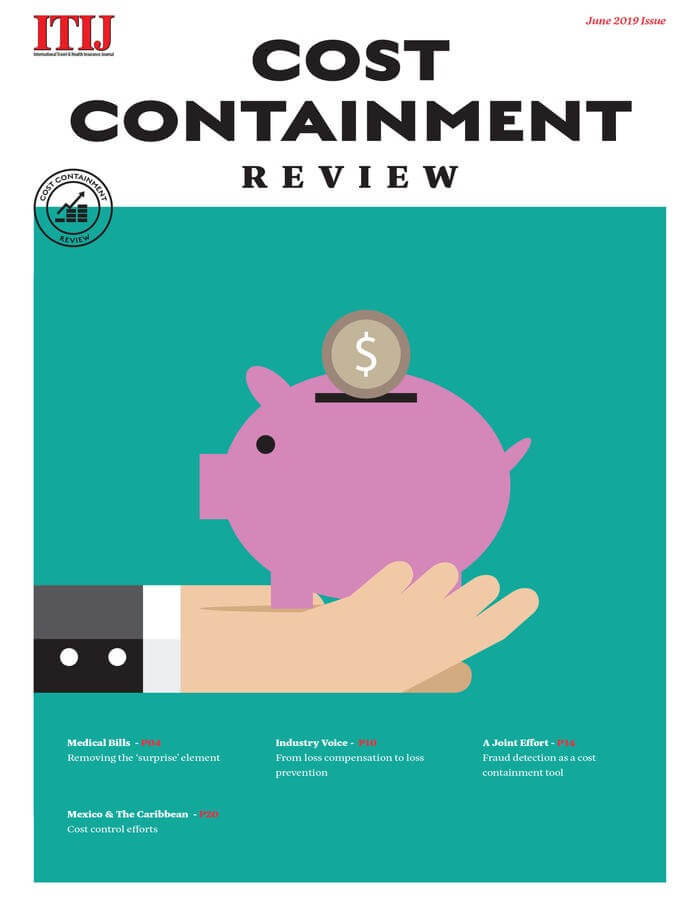
June 2019
Issue
In our Cost Containment Review, you’ll find in-depth articles on avoiding surprise medical bills in the US; global fraud detection and prevention efforts, with a special focus on Mexico and the Caribbean; and how to make the shift from loss compensation to loss prevention.
Robyn Bainbridge
Robyn Bainbridge edits the International Hospitals & Healthcare Review and is a writer and copy-editor for both ITIJ and AirMed&Rescue. Six years a freelance writer, she enjoys injecting a fresh take on a tired topic and is a keen advocate of sustainable tourism. She also has over 15 species of plants in her living room.












February 2025
Issue
Offering readers a deep dive into the issues facing providers and payers of healthcare services around the world. Cost containment, international patient department development, the role of AI in healthcare delivery and more.